If you live in West Bengal, chances are you’ve already heard about the scheme that puts ₹3,000 into women’s bank accounts every month. Officially called Annapurna Yojana and popularly known as the Annapurna Bhandar Scheme, it has become one of the most searched government welfare topics in the state this year — and also one of the most confusing, thanks to the flood of unofficial websites that have sprung up around it.
This guide breaks down what the scheme actually offers, who can apply, what documents you need, and — importantly — where things stand right now, in September 2026, now that the original application window has closed. Every figure below has been checked against multiple independent reports, and the page will keep getting updated as fresh information comes in.
Annapurna Yojana vs Lakshmir Bhandar: What Actually Changed
| Point of comparison | Lakshmir Bhandar (till 2026) | Annapurna Yojana (from June 2026) |
|---|---|---|
| Monthly amount | ₹1,000 to ₹1,700, depending on social category | Flat ₹3,000 for everyone eligible |
| Yearly total | ₹12,000 to ₹20,400 | ₹36,000 |
| Category-based difference | Yes | No — one uniform amount |
| Age group | 25–60 | 25–60 |
| Transfer method | DBT | DBT |
The biggest practical change for most families is simply the amount — nearly double, or in some cases triple, what they were getting before, with the category-wise gap removed entirely.
Who Is Eligible for Annapurna Yojana?
Based on the eligibility conditions published so far, a woman generally qualifies if she:
- Is aged between 25 and 60 years at the time of application
- Is a permanent resident of West Bengal
- Does not pay income tax
- Is not a government employee or pensioner
- Does not work in a teaching or non-teaching post at a government-aided educational institution
Some later reports also mention income-based conditions being applied during verification — broadly, a personal monthly income limit and a household income ceiling — along with some relaxation of landholding restrictions for rural applicants. Since these details have been added and adjusted more than once during the rollout, it’s worth confirming the exact current criteria at your nearest Block Development Office (BDO) or on the official portal before you assume you don’t qualify.
Existing Lakshmir Bhandar beneficiaries are, in most cases, migrated automatically and don’t need to submit a brand-new application — more on the exceptions to that below.
Documents You Need
Keep the following ready, since incomplete or unclear documents are the most common reason applications stall:
- Aadhaar card — must be linked to a working mobile number for OTP verification
- Voter ID card — to confirm you’re a permanent resident of West Bengal
- Bank passbook — a single-holder, active account with a clearly visible account number and IFSC code (joint accounts are a frequent cause of DBT failure, so a personal account is strongly preferred)
- Ration card — for household and family verification
- A recent passport-size photograph
- Residence proof
The application form itself is fairly detailed, covering basic applicant information, ration card data, household assets, income and profession, identity documents, any existing government scheme benefits, and family details. Give yourself a proper half hour rather than trying to rush it.
How the Online Application Worked
While fresh online applications are currently paused (see the status update below), it’s useful to know the process, since it will likely resume in the same format once registration reopens:
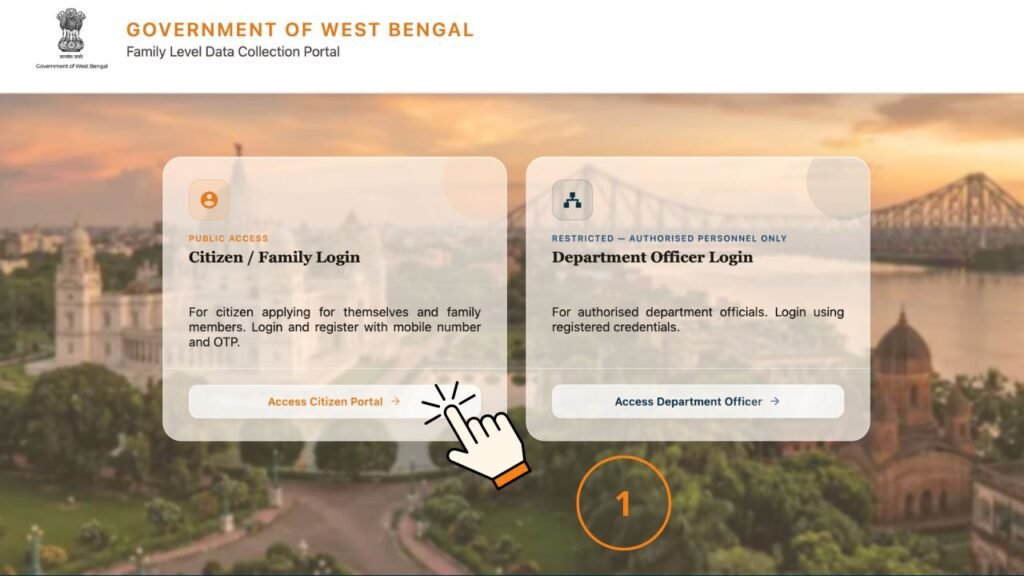
- Go to the official Social Registry portal at socialregistry.wb.gov.in — type the address directly rather than clicking a link forwarded on WhatsApp or social media.
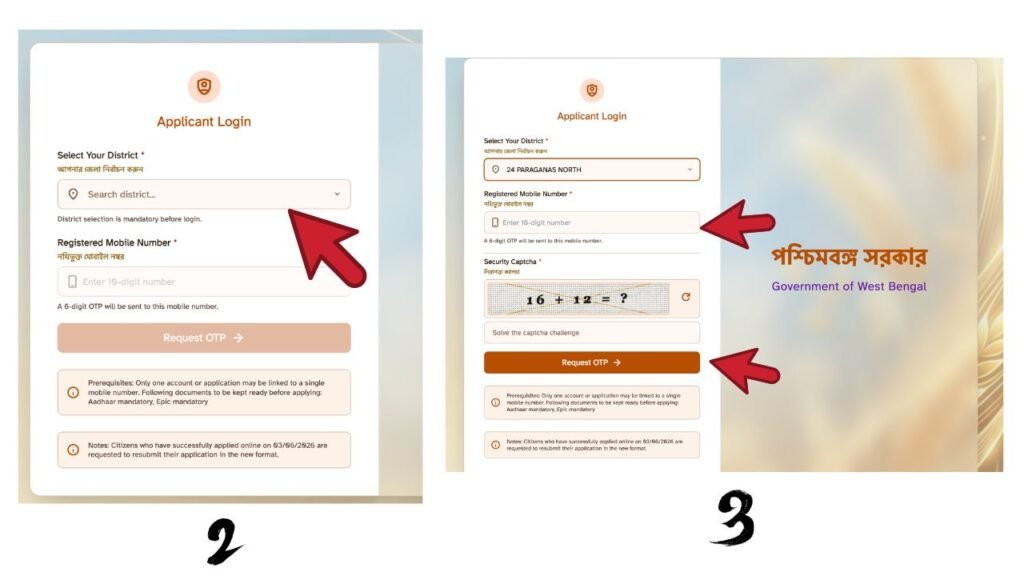
- Choose your district from the citizen portal homepage.
- Verify your registered mobile number with an OTP. If no OTP arrives, your number likely isn’t linked to Aadhaar yet — get that fixed at a service centre first, which usually takes about 3 to 5 working days.
- Fill in every section: basic details, ration card information, assets, income and profession, identity documents, existing scheme benefits, and family details.
- Double-check your bank account number and IFSC code — a single wrong digit is enough to make your monthly payment bounce.
- Upload scanned copies of your Aadhaar, Voter ID, bank passbook, and photograph, typically as JPG or PDF files under 1 MB each. Blurry or cropped scans get auto-rejected, so scan them properly the first time.
- Review the whole form — especially the spelling of your name and your bank details — before accepting the declaration and submitting.
- Note down your Application Reference Number, which appears on screen and is also sent by SMS. You’ll need it to track your status later.
Applying Offline
The offline route has been open since 27 May 2026 and remains the more accessible option for anyone without reliable internet access. Visit your nearest BDO office, municipal office, or panchayat to collect a physical form, fill it in, and submit it along with self-attested copies of your documents. Local MLA teams and BDO staff have also been conducting door-to-door assistance drives in many areas, and outreach camps modelled on the state’s earlier Duare Sarkar format have popped up periodically to take Annapurna Yojana submissions directly. Whichever office you use, hold on to your acknowledgement receipt — it’s your proof of submission if anything needs to be traced later.
English Form
Download the official Annapurna Bhandar Application Form in English PDF format.
⬇ Download PDFবাংলা ফর্ম
অন্নপূর্ণা ভান্ডার আবেদন ফর্ম বাংলা PDF ফরম্যাটে ডাউনলোড করুন।
⬇ বাংলা PDF Downloadहिंदी फॉर्म
अन्नपूर्णा भंडार आवेदन फॉर्म हिंदी PDF फॉर्मेट में डाउनलोड करें।
⬇ हिंदी PDF DownloadWhere Things Stand: September 2026 Status Update
This is the part that has changed the most since the scheme first launched, so here’s a clear picture of where things stand today:
- The original 90-day application window has closed. It ran from 27 May 2026 to 25 August 2026, and by the closing date, well over 1.6 crore applications had reportedly been received.
- Fresh applications from women who have never applied before are currently paused. According to available reports, a new registration window is expected to reopen sometime after 30 September 2026, though this is subject to further government instructions, so it’s worth checking the official portal periodically rather than assuming a fixed date.
- Three rounds of payments have gone out so far. The first, on 3 June 2026, reached 28,25,769 women. The second, released on 1 July 2026, pushed the beneficiary count past one crore. The third round went out around mid-August 2026, taking the total beneficiary count to roughly 1.45 crore women, with several thousand crore rupees disbursed in that round alone.
- The government’s stated target is around 2 crore eligible women once verification of all applications received before the deadline is complete.
- A large batch of older records was dropped during verification — reports put the number at around 30 lakh entries removed from the previous Lakshmir Bhandar database, flagged as deceased, shifted, duplicate, absentee, or non-citizen during the state’s separate electoral roll revision exercise. If your name was part of that list, you would generally have needed to submit a fresh application before the August deadline to stay covered — an exception applies for anyone with a pending citizenship case under the CAA before a tribunal, who continues to receive benefits for now.
If you already applied before 25 August 2026, your form is still being processed through the regular verification cycle, so a “pending” status right now doesn’t necessarily mean anything is wrong.
How to Check Your Application Status
Online: Log in to the official portal with your registered mobile number and OTP, then open your beneficiary profile to see your current status.
Offline: Visit your local BDO or municipal office with your acknowledgement receipt or Application Reference Number, and staff there can look up your progress directly.
Typical status meanings:
- Approved — accepted, with payment expected in the next disbursement cycle
- Pending at BDO/SDO — still under verification, nothing further needed from you right now
- Rejected — an eligibility issue was found; check the stated reason and reapply if you believe it’s a mistake
- Bank account invalid — the account may be closed, jointly held, or mismatched against your Aadhaar name
Since the beneficiary list is refreshed roughly every seven days, don’t panic if your status still shows “pending” shortly after applying.
Fixing a “Bank Account Invalid” Status
This is genuinely one of the most common hold-ups, and it has two practical fixes:
- Visit your bank branch and ask them to check and correct your Aadhaar-seeding or NPCI mapper status. This is usually the simplest route, since most bank staff handle this request regularly.
- Use NPCI’s online Aadhaar-seeding facility yourself if you’re comfortable doing so — you’ll typically need your Aadhaar number and an OTP, and can link a new account, shift your DBT mapping to a different account at the same bank, or move it to a different bank entirely.
Corrections usually reflect within one to three working days either way.
Mistakes That Commonly Delay Applications
- Submitting a joint bank account instead of a single-holder personal account
- Uploading blurry, cropped, or oversized document scans
- A mismatch between the spelling on Aadhaar and on the application form
- Applying through an unofficial website instead of the government portal
- Losing track of the Application Reference Number after submitting
- Ignoring an “invalid bank account” status instead of fixing Aadhaar seeding promptly
Frequently Asked Questions
1. What is the Annapurna Yojana? A West Bengal government scheme that pays ₹3,000 a month to eligible women through Direct Benefit Transfer.
2. Who can apply? Women aged 25–60 who are permanent residents of West Bengal and are not income-tax payers, government employees, pensioners, or staff at government-aided educational institutions.
3. Do existing Lakshmir Bhandar beneficiaries need to reapply? In most cases, no — their details are migrated automatically, provided their bank account is active and correctly Aadhaar-linked.
4. Can I still apply right now? The original window closed on 25 August 2026. Fresh applications are currently paused and expected to reopen after 30 September 2026, subject to government confirmation.
5. Is there any application fee? No. The scheme is completely free. Anyone asking for payment to “help” you apply is running a scam.
6. What is the official portal? socialregistry.wb.gov.in is the government’s registration portal. Always confirm any site you use ends in .gov.in before entering personal details.
7. What should I do if my bank account shows as invalid? Visit your local BDO office with your passbook, or get your Aadhaar-bank seeding corrected through your bank or NPCI’s online facility.
8. Is this the same as the central government’s Annapurna Yojana? No. The central scheme, running since 2000, provides free food grains to destitute citizens above 65. West Bengal’s Annapurna Yojana is a separate, state-run cash-transfer scheme for women aged 25 to 60.